Showing posts with label Amazon business. Show all posts

Sunday, 10 June 2018

How To Start An Amazon Business With Less Than $2,000


How To Start An Amazon Business With Less Than $2,000 


Sharing is caring!

Many people contact us asking how they can get started as soon as possible with their Amazon business, without a huge investment. At Jungle Scout we strongly believe that you can definitely start small and scale upwards. We also have a mantra that getting started (the sooner the better) is the key to success. Chris Jones from ZonLife contacted us to share his insights and processes for starting an Amazon business with less than $2000. As a seller himself, starting out on Amazon UK from humble beginnings, he is highly qualified to speak on this topic. This article is both inspiring and insightful, to make sure you grab a drink and tuck in! 

Getting Started

Starting an Amazon business can be an enjoyable and highly profitable adventure if you identify the right stones to step on and the best paths to pursue. With first hand experience of living the selling on Amazon FBA dream right now, I can tell you that the potential of selling on this platform is enormous.
A main concentration point for people looking to start selling on Amazon FBA would be to build up enough capital so that they can begin. In this case, we’re aiming for a sub-$2,000 start-up, all in.

A little bit about my journey…

My early life wasn’t the what you would call a success story, but ultimately, any failures or roadblocks have motivated me and driven me towards success later in life. Born in Pembrokeshire in Wales UK, my Father was a Farmer and my Mother a district nurse who both worked extremely hard to look after me and my older brother. I was always a bit of a wild child, though, and disillusioned with the whole education system from start to finish. Throughout school I battled with alcoholism, and I was later kicked out of college.
After this I tried my hand at several jobs, painting, washing dishes, delivery driving and working in a warehouse. It wasn’t until I started working as a personal trainer and nutrition coach that I found something I enjoyed. However, I was still not earning enough to make ends meet and I even participated in a clinical trial at one point(!).
Having been through all of this, I was tired and fed-up of not being able to make ends meet. I started to ask myself, “How do I make money while I sleep?” and “How can I generate passive income?”. This was a sure sign that I wanted greater things in life.

My first company was born

I decided to go all in on the Amazon FBA (Fulfilment By Amazon) model in May 2015. I had been reading and watching endless videos on business, selling on Amazon, passive income and much more prior to the set up of my new business.
Chris Jones
I started my Amazon FBA journey with as little as £2,400 ($2,900): everything accounted for. I will define the word ‘everything’ shortly. Afterwards, I turned that seemingly small sum into a much more appealing £8,485 ($10,300), after selling the 500 units I sent in at a selling price of £16.97. Not a bad return on investment (ROI), would you agree?
FYI: I sold out the first batch of 500 units in the first 6 weeks of going live on 16/08/2016.
While this number seems a very respectable income for the first batch of products being sold on Amazon, these sort of numbers do come with some added costs. This first product release was a fat-burning supplement which I sold on the UK Amazon marketplace:
  • Product per unit cost inc. VAT & delivery: £3.40 ($4.15)
  • Cost per each unit label: £0.06 ($0.07)
  • Company set-up: £140 ($170)
  • Graphic design logo: £149 ($180)
  • Graphic design product label: £249 ($300)
  • Total: £2,369 ($2,880)

The springboard for something bigger

Since this my business has grown and I’m about to expand into the Amazon US market which is very exciting. I have also launched my own blog at ZonLife Success to help other entrepreneurs achieve success, which is something that I find very rewarding.
From my humble investment of under $3k into a supplement product, I have since invested in a larger range of products in the Health & Personal care and Grocery niches selling coffee and sports supplements. The business is now making regular daily sales beyond my expectations with high profit margins. Our best month saw over $63k in revenue!
Chris Zonlife
This has not been without some mistakes and learnings along the way. The good news is that there are so many transparent resources out there now (such as the Million Dollar Case Study), so that you can learn the things you need to know in time and learn from other’s mistakes.

Cutting Startup Costs

If I knew as much about the private label industry and the Amazon business model as I do now, I could have dramatically cut the costs of this start up investment amount.
Please don’t dismiss the fact that I shipped from within the country of sale. Meaning, I worked with a UK-based supplement manufacturer and would be selling those private label products over at Amazon FBA UK. If this was being exported overseas, there would be a much bigger cost as there would be freight charges, custom duty and all other things shipping that need to be completed prior to even considering shipping overseas. This personally left my mind boggled when I was starting out, and this is why I focused my efforts in selling on Amazon in the UK.
Ten months later, I found out that you could also ship from a USA-based supplier to USA Amazon FBA – which might have been a bigger base of sales and earnings for my Amazon business, but that would have potentially brought about extra stress, so I left it out.
The point is, there’s lots of approaches you can take when you are starting out. You can try to cut out complicated process, and you can try to keep your costs down to a minimum. I’m here to show you how to do that.
“Build an Amazon adventure and take it to heights that some 9–5ers could only dream of”
I have found that the more love and care you put in to your Amazon business from the get go, the more it will reward you for it in the grand scheme of things. It will allow you to free up more time (passive-income style) so you can work ON your business and not so much IN it, which is essential for business growth.

What You’ll Need

Below are the things you are going to need in order to start up your private label empire on Amazon:
  • $2,000 budget
  • A somewhat creative mind
  • Two hours per day to work on this (side-hustle is totally fine)
  • Internet connection (WiFi it up)
  • A legal company (LTD UK or LLC USA)
  • A bank account 
  • A graphic designer
  • Private label supplier to work with
  • Freight forward contact for oversea shipments
  • A mindset of mastery (believe and you shall achieve)

The process 

The product research process is definitely an important launchpad for your business. Here’s my top tips for ensuring you are setting yourself up to launch for under $2000. This will save you time and money in the long-run.

Product research / selection

Naturally, if you want to do your product research well, find hundreds of ideas and narrow those down into feasible product options, then you’re going to need some tools. Getting accurate estimated sales data and other metrics is really important when finding products with high opportunity and demand, but low competition.
If you are looking to invest in a product research tool like Jungle Scout at this point, then you may want to add this cost to your start-up investment. Personally, I think this is an invaluable investment. It will also provide a long-term benefit, because it is going to help you stay ahead of the curve post-launch, and grow your business or add new products in future.
Here’s a few tips for things you should be doing during the research phase to ensure you are able to keep your costs low…

Cross-reference selling prices and cost prices

Find the sale price of the products you might be looking to consider and cross-reference these selling prices with average cost prices on Alibaba.
Doing cross-reference price checks will help your product research phase by allowing you to see what profit margins are potentially available to you. This is obviously important no matter your startup budget. If you are looking to launch with less than $2000, it also allows you to work out roughly how much your cost price might be for your first 250-500 items of inventory. 
If you are looking at high-cost product ideas, this might not work out, and you may want to bench those ideas for later.

Use the Amazon FBA Calculator

This is a tool that anybody looking to start an Amazon business should be leveraging. The FBA calculator lets you input certain data about a product that you are looking to sell at a similar price point to the one you’re looking to sell it at. You can also add the cost price of the product. All of this data is collected and displayed right in front of your eyes and it lets you see the costs that come into each and every sale made.
Again, you should then be able to figure out how these costs fare when you are purchasing your first round of inventory, and whether that will be feasible within your $2000 budget.
Tip: When the FBA calculator asks you to input the ‘Cost of product’, make sure you head over to Alibaba and see how much the product is selling for on average. To be safe, take the higher cost price of what that private label supplier is advertising.
FBA Calculator Amazon

Find products that are small, light and easy to ship

This is especially useful when you are just starting out, to avoid unwanted set backs. It’s even more important when starting on a smaller investment. Make sure your products can fit into a shoebox and are light, this will save on shipping costs. This will also reduce any potential shipping issues.

Avoid big brands 

By this, I mean avoiding entering any markets on Amazon that are dominated with big brands selling in them: brands such as Converse Chuck Taylors in the shoes department (or ‘kicks’, as some of you youngsters may say), Adidas clothing, iPhone chargers against the likes of Apple (this might land you in some trouble anyway so best to stay clear).
In essence, you DON’T want to compete against the big boys in the market and you should rule them out completely in order to play it safe (or safer).

General rule of thumb

So to conclude, we are looking for:
  • Light in weight
  • Small in size (can easily fit into the average sized shoebox)
  • Non-seasonal (is in demand year-round)
  • Easy to ship 
  • Low risk (don’t go selling knives or luxury plate sets)
  • Re-usable (a product that is bought multiple times per year)
These criteria are vital for starting out your Amazon business the right way: maximizing your chances of success and minimizing all other elements of risk. This will also ensure that you can move forward with a $2000 start-up investment, and still see great success.
Throughout all of these processes, you will often find yourself in more of a pickle (‘a confusing and frustrating state’, for those of you who don’t speak British) than in the sweet-spot of product research mastery.
The main thing is that you are constantly seeking the long-term outcome throughout this process and do not give up when it comes to the apparent ‘failure’ upon the first few hurdles that you are challenged with.

A Perfect Product Example

Below is a screenshot of a product that I have been looking at that has a more than respectable amount of sales flowing through for its main keyword – with the revenue figures to back it up.
Amazon sales

FYI: The data you are looking at is all over the course of a single month (30-day results)
The biggest factor that I would be focusing on here is the amount of reviews for the different private label products that are not of great amounts yet are generating a very nice volume of sales per month.
This, combined with the resources I have listed earlier on, can be a vital asset to your already powerful arsenal. You can now dig deeper into the product research phase knowing you have some solid figures to work off. You are now able to check the demand on Google trends, look for a higher-end cost price of what the product is going to cost you on Alibaba, weigh up profit margins and other fee breakdowns using the Amazon FBA calculator, and also start further inspection of the products on Amazon.

Is this a guaranteed goldmine?

No, of course not. Nothing is guaranteed, but when it comes to adding more security to your decision this example would hit that nail on the head every single time.
I would be looking to enter this market NOT with the mindset of capturing a large percentage of the market share – such as 20%, 30% and so on – but moreso to work my way into tapping into a small majority of the market share.
I mean if I was to bring myself in 15 sales per day (450 units per month), which is not a huge ask, I could bag myself a nice total revenue of £11.99 ($14.60) per sale, which would work out at £5,395 ($6,560) over the course of 30 days. Please remember, sales do not stop on weekends.
Let’s assume your total net profit margin is 30% – which is not a lot to ask for, either. This means our take-home cash (Cha-Ching) would be an average of £3.60 ($4.40) per sale. Calculate that number with the 15 sales per day over the course of 30 days in the month and you will have cashed a very cool £1,620 ($1,970) in your pocket (or into your re-investment plans for your Amazon business).
Congratulations, you now have the opportunity to earn more than the average worker’s wage in the UK based off one single product release, doing 15 sales per day at the low end of the net profit margins of 30%.
Total annual take-home (pre-tax) = £19.440 ($23,620).
Not bad for a sub $2k investment, right?

Samples

The average cost we are up to with the start-up of your Amazon business at this current stage, tools aside, is a grand total of $0.
Once you have found some potential suppliers on Alibaba, you will first want to order a sample of your product. Naturally, this is going to cost some money.
Tip: I sometimes prefer to order the sample with full branding of my label, complete with logo and full graphics: this way I don’t have to get it sent out a second time after receiving a plain first sample product (such as a coffee glass with no branding on it). It could save you both time and money!
We order samples so we can look, test and inspect all aspects of the product’s quality. It’s vital to complete this process otherwise you are casting your rod into a potentially empty, yet dangerous, ocean.
Just imagine rushing this phase and ordering a bulk amount of 250 coffee glasses that seemed fabulous by the photos on the supplier’s Alibaba listing, but when they are actually opened by your paying customers the coffee glasses are of low quality, the wrong color branding, with crushed outer packaging: leaving  nothing more than a bad taste in those customers’ mouths. 
Not worth the risk. Not at all. Play it safe and order samples. This goes for each and every new supplier you are looking to work with to create your products for you.

Before you order your sample…

Make sure you ask about each suppliers ‘minimum order quantity’ (MOQ). This is where the supplier sets a limit for how many units can ordered from a buyer. For example: a supplier selling ‘coffee glasses’ might have a MOQ in place for 3,000 units. This shows that you will have to (most likely) order 3,000 units of this private label coffee glass in order to place any order at all.
Sounding a little steep? Well, there is ways around this or certainly ways to reduce the MOQ by at least 30–40% if you know how to negotiate. But ultimately, you are going to need low MOQ’s to launch with a smaller investment.

Negotiating smaller MOQs

Always approach suppliers in a professional and serious attitude, but don’t be afraid to stand your ground and let them know what your wants and needs are. If you are negotiating a smaller MOQ for your first inventory shipment, make sure you let them know that you mean business.
One technique is to say that you want to test the quality of the product with them for the first order, and give an indication of how many units you expect to be ordering over the course of the following year, based on your product research projections.
Tip: For smaller MOQ’s, try Aliexpress, and also Google search. Yes, you can find suppliers by typing in relevant search terms on Google too.
Aliexpress is similar to Alibaba but deals on a smaller scale, offering much smaller start-up quantity amounts. But do be careful as, when ordering small amounts, the cost of the product per unit (and the shipping) is often much higher. You need to find the right balance between getting a good cost per unit and a low enough MOQ to keep your start-up investment under the $2k mark.

Order victory is near 🙂

After loving the look, feel and quality of your product samples, now is the time to get seriously committed and place that order that you have been dreading for the last few weeks.
I can hear your heart beating and sense your hands getting all clammy from here. Worry not, private label solider. You are on the right track.
I always opt to use PayPal to pay suppliers, especially for smaller amounts. This provides quality protection and enables the transaction to be processed quickly. PayPal to take a percentage fee, though, so this is perhaps not the best route long-term once your business is growing and you are ordering huge amounts of inventory ;).
To give your eyes a break from the reading, I’ve included a useful video on cross referencing price and product selection factors:

Detailed Cross Referencing Breakdown

Here’s an in-depth cost and profit breakdown so far for an example product:
  • Product: Coffee glasses
  • Main keyword: Coffee Glasses, Coffee Cups, Coffee Mugs
  • Amazon marketplace: USA
  • Shipping from: China
  • Alibaba average cost price: $1–2 per glass but we will go for a bundle of two coffee glasses which will cost $3 each, (all custom branded EXC delivery).
  • Average MOQ: 250–500 pieces
  • Average sale price on Amazon USA: $30 (make sure you see exactly the coffee glasses people are buying more of here. Are they single glasses or a bundle? Such as a set of 6 for example).
  • Average shipping cost per unit from China to USA: $3 
  • Estimate Amazon fees per unit each unit sold: $7.00
  • Estimate Amazon monthly storage fee per unit: $0.55
  • Average NET profit margin per every sale made: $13.95
  • Average NET profit margin percentage: 25%
A realistic and non-overwhelming goal to aim for would be to sell ten units per day at $30, working on a profit of $13.95. Sales don’t stop on weekends which would bring you in a total of 300 sales per month.
NET profit per month: $4,185

Tip: You can use the Jungle Scout Chrome Extension to get reliable estimated monthly sales, allowing you to get a data-backed goal of how many units you will be able to sell per day. This helps with your business projections.

Now, this profit is quite generous, as you will also want to enter any other additional expenses that you have, which can vary. You would also need to account for any marketing spend such as on Amazon PPC. Having said that, there’s plenty of room for movement with this amount of profit to be able to put a bit of that cash into making more sales.

Detailed Cost Breakdown

So, what does this tell us about the product that we could be potentially selling on Amazon?
It shows us that there are many costs and fees involved with starting up a Amazon business but I have been careful not to hide or hold any fees or costings back from you when collecting the information above.
Here’s a view of the costs breakdown for the trusty ‘coffee glass’ product (two coffee glasses in a set), so that you can see how we’re keeping this within the $2000 start-up amount:
  • Product Research Tools: $69 (In this example, the Jungle Scout Web App, which has helped to find and verify this product idea, carry out competitor research and back my decisions with real Amazon sales data)
  • Product per unit cost inc. VAT but excluding shipping: $4
  • Negotiated Minimum order quantity: 250
  • Supplier source: Alibaba
  • Estimate production time: 4 weeks
  • Estimated shipping time: 4 weeks (via sea shipping)
  • Estimated cost per each unit label: £0.06 ($0.07)
  • Company set up: $29.99
  • Graphic design logo: $15
  • Average graphic design product label: $50
  • Product photography: $129
  • Amazon monthly subscription fee: $39.99 after first 30 day free trial
  • Estimated shipping per unit: $2.50
  • Amazon PPC (pay-per-click) Campaigns: $100 to boost your product launch
Start-up investment total = $1,950
To help you document these breakdowns for your product launch, I have created a useful spreadsheet swipe file that highlights all of the breakdowns in this post. You can save a copy of this spreadsheet for your own use, enter your own costs, and get your startup costs and an estimated profit breakdown. You’re welcome!

Overview

Did I pass the test? I think that this is a very easy to follow example of some of the most important costs you need to account for in your product launch. Everything from product costs, shipping, labelling, photography and design has been accounted for. After all, you want to be able to create a good product listing with some solid images for your first ever launch.
I have even included additional costs for your first month of product research tools, which are imperative to reducing the risk of failure, and some Amazon PPC for when you launch to help you along the way.
If you are good at photography or design, then maybe you will do those parts yourself and spend a little more on inventory or PPC. Each case is different but I hope this example gives you an insight into the fact that you can start your Amazon business with less than $2k.

Disclaimers

Because of the speed of implementation that we are aiming to achieve here in getting started, we do not have to look too far into any fancy designs, packaging or any major additions for our private label product. We are looking to jump on the bandwagon while it’s hot and then once all set up and selling, we can then look to further improve that product. By this point, your product will have started to generate profits.
Following this, you will want to continue the momentum and start to work on your Amazon marketing. There’s lots of things you can do on a low-budget to increase sales, such as running promotions for a short period, setting up email campaigns for your customers to gather non-incentivized reviews, improving your keyword research and optimizing your product listing.
Tip: Read Amazon’s Terms and Conditions in the early stages, it will allow you to begin and continue your Amazon business in much safer, smoother and faster fashion from launch. I think everybody should take the time out to do this instead of potentially getting into a dilemma down the road when your sales are booming.

Amazon Business Reality  

Congratulations! You have come far in your start-up journey to financial, time and life freedom… But now is the time to make some sales for your private label business on Amazon FBA.
“You mean, I’ve just gone through all of that and I still have to make an effort to generate actual sales?”
Um, yes sir. Unfortunately money does not simply grow on the far-reaching branches of the Amazon jungle trees.
Reviews are going to be a massive – and ongoing – focus point with your Amazon success.

Reviews are important

The people with more reviews for their products on Amazon are most likely going to take the gold when it comes to participating in this sometimes challenging game. I am not saying that reviews are the be all and end all of creating massive success selling on Amazon but it definitely plays a substantial role in the process.
product reviews
Aim to achieve 15–25 product reviews on your listing as soon as possible. Thereafter, you can begin the PPC (Amazon’s internal pay-per-click) process to further increase exposure and sales for your Amazon business.

Setting Goals

Your ultimate goal for your Amazon business is to rank your private label product up to the first page of Amazon for its main keyword and maintain that position for the long term. It helps to continuously clock up more reviews (you can do this by increasing the value of your product and outstanding customer service);  maintaining a great Amazon account performance; and driving traffic from various social media platforms to your Amazon product page (Amazon loves incoming traffic).
These things, done right and consistently, are going to help you reach heights of success. It doesn’t matter if you started with $2k, $4k or more. The key is that you get started on this journey and consistently scale and improve.

Reinvestments

I would advise thinking about re-investing the majority of your earnings straight back into your business by buying more products at given times. Remember, bigger order quantities reduce your overall cost price of each unit purchased from your suppliers.
This plan of attack will not only help you to grow your Amazon business a lot faster but will also help you to understand the Amazon business and overall private label industry much better as a whole.
“Re-invest in the short term so you can live out your dreams in the long term.”
Another great point to make here is that the more you practice this process of product research, supplier negotiations and all other elements of business, the more knowledgeable you will become.

Conclusion

Now that you have all of the ammunition needed to start, maintain and sky-rocket your Amazon business, you now need to either:
  • Take immediate action
    OR
  • Close this blog post and chuck its content-rich pages of wisdom into a fire.
If your decision was to go with the former then I have full respect for, and full confidence in, the journey that you are about to embark on, my good friend. Not only are you about to add a nice chunk a’change to your back pocket but you have also proven to yourself that anything is possible with a little piece of action pie.
Congratulations, you!

Saturday, 24 February 2018

HOW TO START AN AMAZON FBA BUSINESS

I have been selling online through an Amazon FBA business since 2013, but I haven’t really spoken about it much on this blog. I hesitate because to a reader I think it sounds too easy. There are a lot of the articles written about Amazon FBA and they too often just like a scammy get-rich-quick scheme.
The logic is simple and the businesses are very profitable, but they do take time and are a lot of work to get going. It is worth it, but you should treat your Amazon FBA business seriously and just like any other business.
Contents [show]

What is an Amazon FBA Business?

I am sure you have heard of Amazon. It is the largest online retailer in the USA, UK and much of Europe. A household name. But what you might not know is that when you purchase something from Amazon, there is a very good chance that you are buying from a third party seller using a service called Amazon FBA.
FBA stands for ‘fulfilment by Amazon’. What is means is that Amazon looks after all of the seller’s stock. When a customer places an order, it by-passes the seller altogether and goes straight to the FBA warehouse. Amazon then picks out the order and delivers it to the customer.
Amazon FBA also handles most of the customer service. They process all customer returns and only the most specific queries get forwarded on to the seller.
To the customer, there is almost no difference between purchasing from Amazon directly and from a person selling their items on Amazon through Amazon FBA. They get the same delivery options, the same returns policy and the same customer service team.
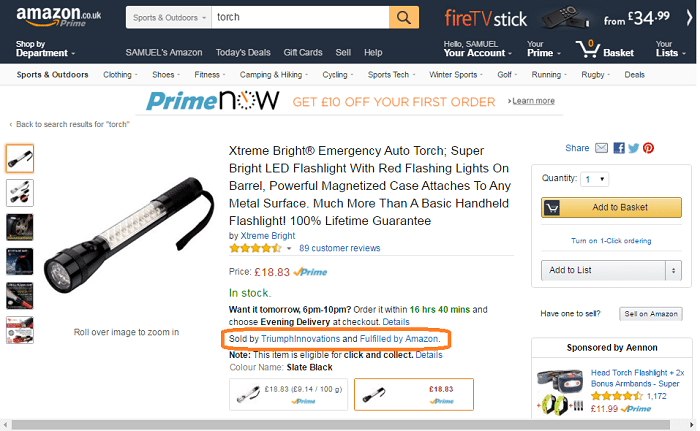
In the image below you can see that the torch below is sold by ‘TriumphInnovations’ and ‘Fulfilled by Amazon’. ‘TirumphInnovations’ is an Amazon FBA business.
fulfiled by amazon
An Amazon FBA business is a great intermediary between a bedroom eBay business, and a full-time brand with a large staff. As a seller, you don’t have to look after the stock and it takes the same amount of work to sell 10,000 items as it does to sell 10. But to the customer, they get a quality of service that is on par with the biggest brands in the word.
As a seller, you can run a one-man-band business that sells thousands of items each month, all remotely from anywhere in the world. In fact, I am currently in South America with Amazon FBA businesses in Europe and North America.
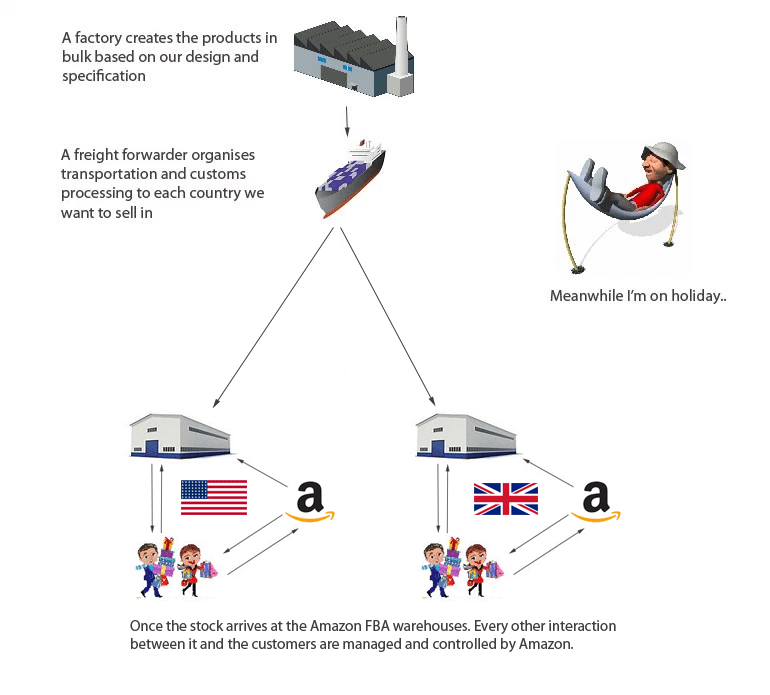
You acquire the stock and get it delivered to Amazon FBA. Then all you need to do is focus on getting sales.
amazon fba business
In this article, we will talk about the main two types of Amazon FBA businesses. (there is one other type is completely different that I covered in this article: Retail Arbitrage).
  1. Invent a product from scratch. Get it professionally designed and manufactured. Then work your arse off to try and convince people that they really want it and will buy it. This is the approach we follow and I documented for the table tennis bat cases in this post. It’s a lot of work and you run the very real risk of discovering that people don’t really want whatever you have invented.
  2. Reinvent/improve on someone else’s product. Simply find a not very good item that is selling well and create a better version of it. There are hundreds of items on Amazon that are just rebrands of readily available white-label products. You can even find the same factory that makes the original item and get them to do your manufacturing. As of 2016, this is the easiest and still a very profitable route to take.

How to Source Your Products

We’ve spoken a lot about Amazon, but there is another global company that is almost as important. Alibaba.
Alibaba is a Chinese online wholesale market where factories and distributors from all around the world display their items. Most of these companies will work with you to create and manufacture your unique product.
Since Alibaba came on the scene it has got very easy to create a basic Amazon FBA business. Too easy. And has led to Amazon getting flooded with white-labelled products that are straight from Alibaba with a brand attached and a huge price markup. Most of them don’t sell well, but there are plenty that do.
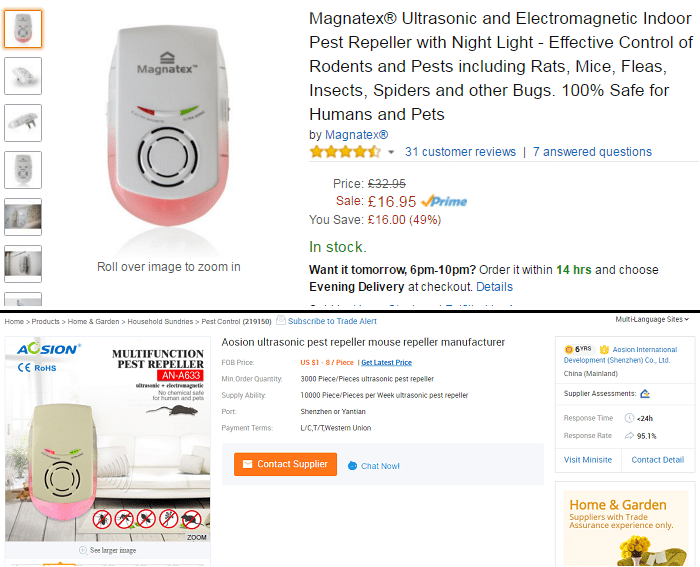
Here’s an example.
pest control same
The only difference between the two is the adding of a brand name… and the price increase.
You can buy them in bulk on Alibaba, branded with your own brand for between $1 and $7 each (depending on how many you purchase and how good you are at negotiating), and people are buying them on Amazon for £16.95. Even with all the fees and costs (which we will talk about later), that is still a very good profit margin.
Now I can’t be 100% sure that it is the same factory that makes both of them. But it doesn’t really matter. Provided the factory is able to make us a better version, then we’re in business.
Now that pest repeller looks pretty low quality, but you can also find very high quality, well-respected brands on Alibaba.
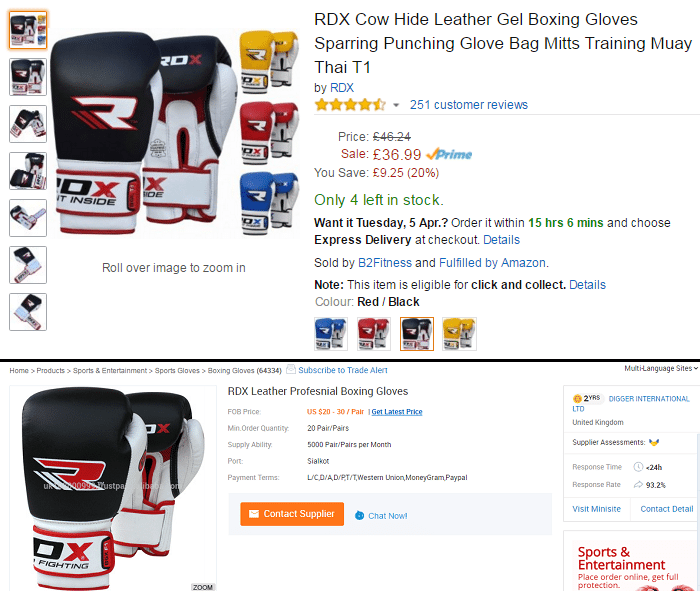
The next images are of a very popular supplier of boxing gloves on Amazon and Alibaba.
amazon fba business boxing gloves
On the Alibaba factories’ website, they describe themselves as: “the official supplier of ‘RDX’ one of the world’s leading fitness brand, along with many other brands.”.
I am not suggesting that you should try and create fake RDX gloves. That would be unethical and also bad business – it wouldn’t take long before you were shut down. But I am suggesting that if you can come up with an improvement to the boxing glove, you could legitimately contact that factory on Alibaba, get your own unique boxing gloves made, add your own branding and start competing with RDX.
Getting a really good idea for a product can take quite a bit of time and research, and is worth not rushing. In fact it is a full topic in its own right. You can check out my in-depth guide here.
But in short:

How To Do Market Research On Amazon

To get an idea of what is selling and for how much I use a market research tool called Jungle Scout.
It is a deep search tool for Amazon that compares each listing with its own data to work out how much your competitors are selling a month. It costs $69 a month (for the web app version with niche-hunter I am using below) and you can cancel it once you’ve chosen a product.
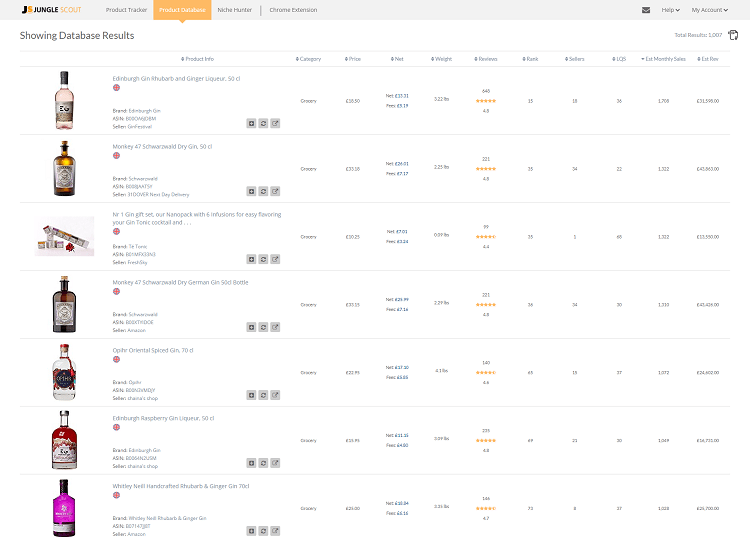
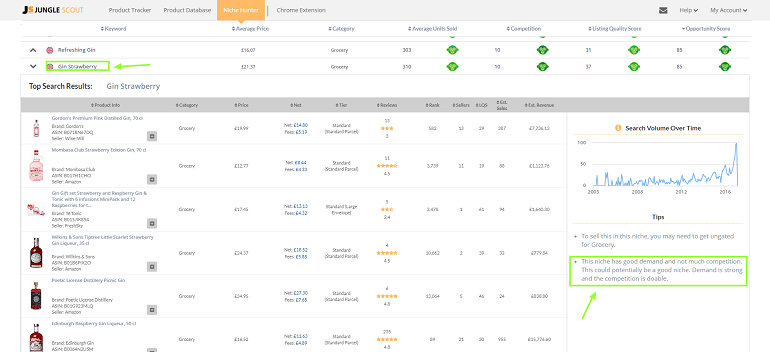
I am currently in the process of starting a new Amazon FBA business selling gin (Warning: I don’t recommend you start with something as complex as alcohol), here are some real screenshots I took from my own market research in October 2017:
You can see that it includes a lot of the information that would be useful for finding a product that is selling well with not great reviews.
And here is the niche hunter for going deeper and looking for keywords. It seems that there is a gap in the market selling strawberry gin:
There is more to finding a good product (size, weight and price is also important), but we don’t need to go into that much detail right now. If you’re interested you can bookmark this post and come back to it later.

Getting Your Stock From Alibaba to Amazon FBA

The final piece of the puzzle to setting up an Amazon FBA business is how you get your stock in bulk from the factory to the FBA warehouses. On the surface, it can be very complicated. Every country has different customs processes and Amazon have some pretty complex requirements for how they need your items to be delivered.
Thankfully there are plenty of companies that deal with all the hassle for you and make it really easy, they are known as freight forwarders and customs brokers. I recommend Flexport. They are funded by Google, have a really good online interface and due to the transparent price comparison service, are cheap.
The steps are fairly simple:
  • The factory delivers the stock to the Flexport freight forwarder.
  • The freight forwarder gets the stock into your destination country and deals with all taxes and paperwork.
  • The freight forwarder hands the stock over to the Amazon partnered couriers who books them into the FBA warehouses.
Simple eh? Well that’s the basics of an Amazon FBA business:
  • Find a factory on Alibaba.
  • Open conversations with them and design your product.
  • Get a large batch of the item manufactured.
  • Use a freight forwarder such as Flexport to get the items from the factory to Amazon.
  • Get marketing and sell your items.
Now let’s dive into the nitty gritty.

Pricing

If you have done some browsing on Alibaba, you may be a bit shocked at how cheap the factories are selling wholesale quantities of their goods for. Unfortunately, it’s not quite as simple as taking the price you sell it for and minusing the price you paid, There are a lot of costs to include.
I am talking about pricing and margin early on because it is so important. You can’t start talking to manufacturers until you know how much margin you need.
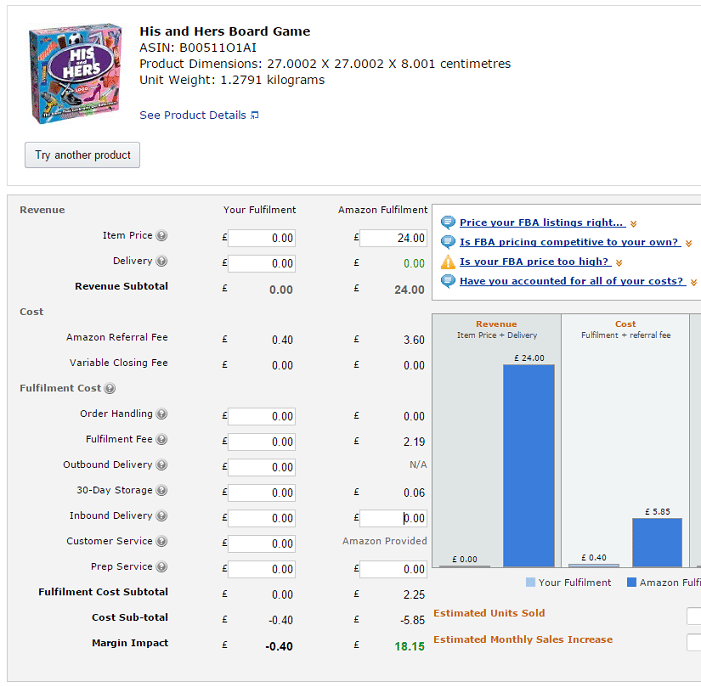
Luckily Amazon has a handy calculator that you can use for most of the costs:
retail arbitrageJust find an item similar to yours, or enter in your product’s dimensions.
On top of these costs, there are a few other ones you need to add in manually.
  • The price of the item.
  • Shipping to the country.
  • Tax and customs charges.
  • Delivery to the Amazon FBA warehouses.
You can talk to Flexport and the Alibaba factories to get all these costs.
A typical example might be:
  • You expect to be able to sell the item for $16
  • It costs $4 per item to buy.
  • Shipping is $1 per item.
  • Tax and import duties are $0.75 per item.
  • Delivery to the FBA warehouse is $0.2 per item.
  • FBA fulfilment fees are $3.05 per item.
  • Amazon closing fee is 15% of sale price, so $2.4.
  • Your profit is $4.6 per item.
That is still a good margin and provided we can get sales is a good Amazon FBA business.
Because of the way the Amazon fees work, your ideal product will be:
  • Selling for between £15 and £50 ($20 and $70).
  • Small and lightweight.
  • Simple and with not too many moving parts.
And of course, an item that people want to buy. As mentioned earlier, finding the best products to sell on Amazon has it’s own whole post here. In short, there are a few great tools that can help you research the ideal product. JungleScout is probably the best and most popular.
Once you understand how the margin and fees work, the next step is to start chatting with some manufacturers.

Finding A Manufacturer

I suggest talking with as many factories as possible.
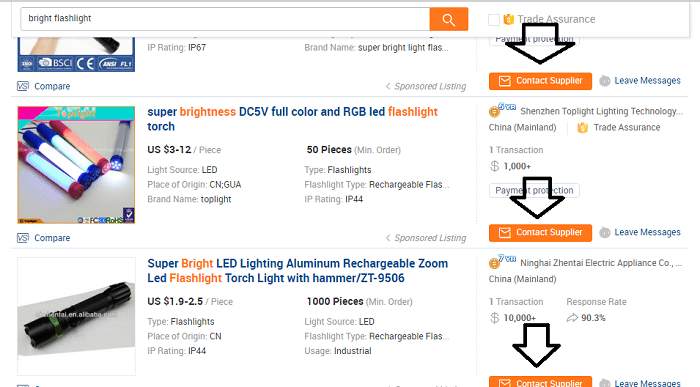
With Alibaba it is so easy, just use the search bar for whatever you are looking for and click “contact supplier” next to the companies that look interesting.
When searching add the word ‘OEM’ to the end of your search. For instance “Flashlight OEM”. It stands for ‘original object manufacture’ and should filter out all the re-sellers and give you the factories that actually manufacture the items.
You might as well shoot off the same message to lots of different factories and then play them off against each other. The factories know the value of even a new Amazon FBA business and will want to work with you.
Alibaba contact supplier
It is very hard to describe what I look for in a good factory beyond “a good feeling”. I think it comes with practice. I suggest that once you have spoken to them, try having a chat over Skype. If their English is so bad you can’t really communicate, then it is probably not going to work out.
Once you have narrowed down your search to your favourite 3 or 4 factories, ask them to send you out a sample. Some places will send you one for free, others will charge you but then take the cost off any large order you eventually make. A few will ask you to pay full price.
Once you have samples from a couple of factories you are happy with, it is time to move onto the next step.

Prototyping

Now remember, we are not just looking to re-sell their products. We want to improve and customise them.
This process can take quite a long time, but it is worth getting right. If you can get the designs done professionally, that could really help to really speed the process up. You can hire a freelancer on Freelancer to help you.
Or you can make amateur suggestions and ask the factory to turn them into products. Here are some designs we made in Microsoft Paint for our table tennis bat cases.
One of the keys to an Amazon FBA business is keeping costs as low as possible. So make sure to think through what is the best use of your money.
eastfield version 2
During this design phase, you need to incorporate a barcode. A barcode (or UPC code) is a series of digits that is unique to your product all over the world. There are plenty of websites where you can buy barcodes, this is the website I use.
Once you have the perfect prototype it is time to get them manufactured.

Negotiation and Manufacturing

Although I hate negotiating, on Alibaba it is a requirement. You can often get 40%-70% off the asking price.
As it is so easy for customers to price compare a lot of factories are starting to realise that they can get more business by opening with their best price. But I think it will still be another few years before you don’t need to negotiate.
You may be great at haggling and love competing for the best price. If on the other hand you’re more like my, here are my thirty seconds on negotiating on Alibaba.
There are a few things we really care about:
  • Minimum Order Requirement.
  • Price.
  • Lead Time.
At the beginning, the first one is the most important. You may be able to get a great deal if you order 10,000 items, but that would be crazy for a new product you haven’t tried to sell yet. If no-one buys it you’re left paying storage on 10,000 items! I recommend starting with about 500.
On lead time, sometimes the factories can take months to create your product. If you’re just starting out you may well be willing to sacrifice a bit of margin to get your products to Amazon quicker.
If you have a few different good options for manufacturer you can play them off against each other on choose the best deal.
The only other thing I would say about negotiating is: don’t burn your bridges. The first manufacturer may turn out to be a dud and you may want that second one. So even if you don’t go with them, leave the option open for future business.
When you finally give them the go-ahead, make sure to request that the items are packaged together in the same size cartons. This will be important when organising the final part of the delivery to Amazon.

Freight Forwarding & Customs

I’ve already mentioned that Flexport or another freight forwarder will do most of the work of shipping and customs for you. They’re generally good enough that I don’t need to go into much more detail. Except to talk about shipping options.
You have the choice of sending your stock by ship or by plane.
A shipment from China to the UK or the USA will take 6-8 weeks. By plane, it will take less than a week. But plane will be about five times more expensive.
If I am running low I will fly in some emergency stock, but the majority I send by boat. On your initial order you could always send a small amount, say 60, by plane and the rest by boat. That way you can be up and selling much quicker.

Amazon and Amazon FBA

Once your shipment has landed in the destination country you need to get it to the Amazon warehouses.
But first, you will need to create an Amazon account.
I strongly suggest creating the account before you start manufacturing. 
It is free to sign-up as an ‘Individual’ Amazon seller in most countries and anyone from most countries can do it. India is the only exception that I know of, there you need to have an India-based business to register. I suggest starting with just one country, the one you are most local to:
There are two types of Amazon accounts. Individual and Professional.
  • Individual is free but you pay an extra fee per item sold, you also have access to less analytics.
  • Professional charges a monthly fee.
Both can be used with Amazon FBA, so I simply suggest signing up for an individual account and upgrading once your sales hit the threshold where the professional account is cheaper.

Creating the Listing on Amazon

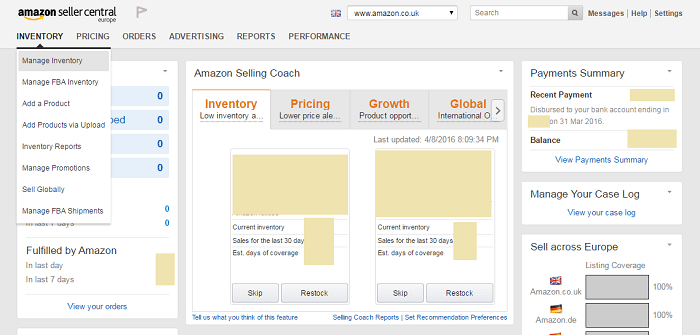
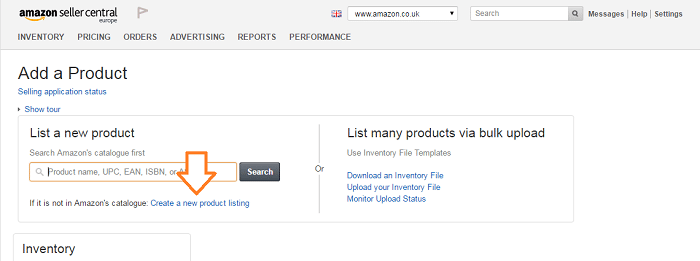
Once you have finished creating your account. From the homepage navigate to the inventory tab and select “Add a Product”.
Amazon seller homepage
Select “Create a new product listing”. Then select the most relevant category.
select create new product
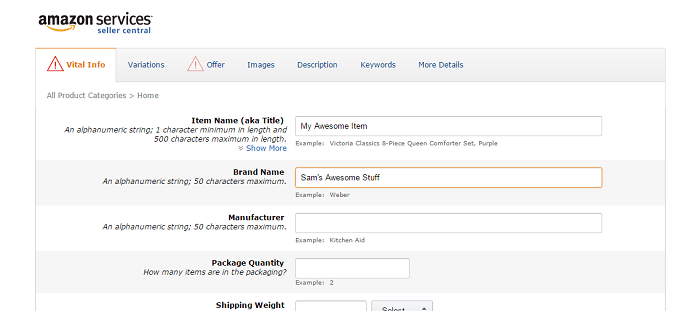
You will then be taken to the details page of your new product. There are hundreds of fields, but most of them you can safely ignore as they don’t really add anything. Make sure to fill out:
Under ‘Vital Info’
  • Item Name. I like to include the brand name here as well as it it is what the customer sees when searching through Amazon. e.g. “Awesomo Fly Swatter Mk2″
  • Brand Name. This is your Amazon FBA business brand. e.g. “Awesomo
  • Recommended Browse Node.
  • Product ID. This is the UPC number that you purchased when designing the product. It is the unique barcode.
Under ‘Offer’
  • Your Price.
  • Condition.
  • Fulfilment Channel = ‘I want Amazon to dispatch and provide customer service for my items if they sell.’
The fulfilment channel is important. This is where you tell Amazon that you want to create an Amazon FBA business and have Amazon handle your stock and customer service for you.
Under ‘Images’
Images are very important. Make sure you have someone take some professional looking photographs of your item.
Under ‘Description’
Make full use of this page and make your product sound as appealing as possible.
Keywords
Enter a few alternative words that people might search for your item. For instance, if you are selling a pest repeller they might also search for ‘bug repeller’ or ‘mosquito repeller’.
create an item

And that’s all you need. Now click ‘Save and Finish’.

Sending Stock to Amazon FBA

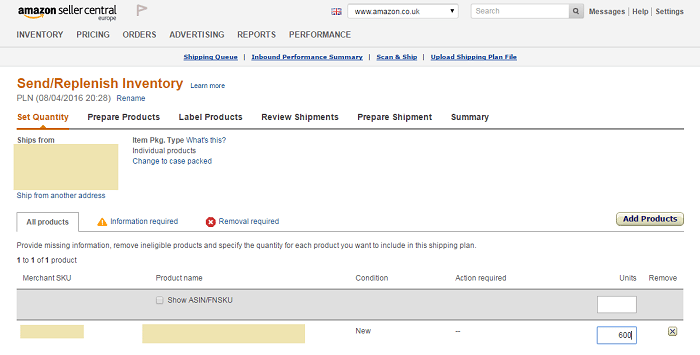
Provided you selected that you want Amazon to fulfil your items, you will next be sent to the ‘Send/Replenish Inventory’ page.
ship from...
Just follow the instructions. At some point, you will be asked for some more details about your item, including the proportions and weight.
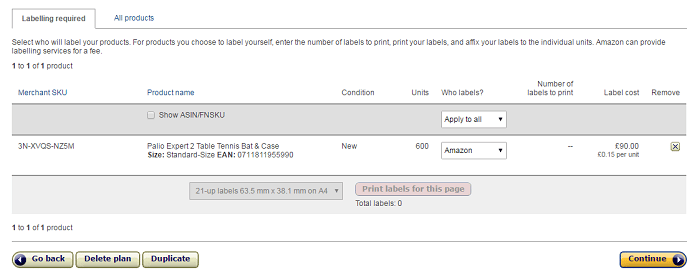
Every product sent to Amazon needs to be labelled with a label that is unique for the item and shipment ID. This is an internal barcode that Amazon uses to track and manage inventory. You can either get your freight forwarder to do this or pay Amazon to do it.
I’ve found that the freight forwarder is normally a cheaper option, but there’s not much in it and it is more work on your behalf. To get them to do it you need to negotiate it as an added extra, then download and send them the PDFs of the labels.
amazon fba business labelling
Once you have clicked through all the steps you will have a chance to review and accept the shipment.
Once it is created select ‘Work on Shipment’ to tell Amazon how it is going to be delivered.
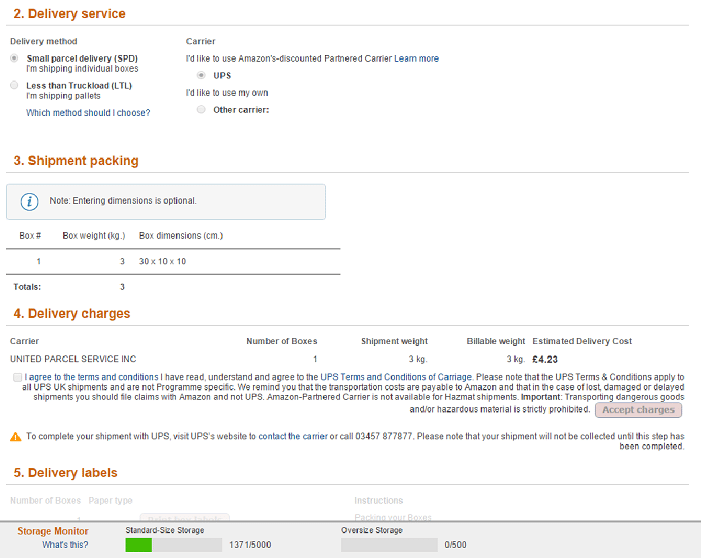
The easiest way is to select ‘Small Parcel Delivery’ and choose the ‘Amazon Partnered Carrier’.
Remember how we made sure that all the cartons sent by the factory were of the same size and weight? This is why.
By using the ‘Amazon Partnered Carrier’ (which is UPS) you will pre-pay for delivery based on the number and proportions of the boxes you are sending. Amazon will then generate you a pre-paid label in the form of a PDF file.
Just gives these PDF files to the freight forwarder, they will attach them to the cartons and give them to UPS. Next thing you know your stock will be at Amazon.
amazon fba retail arbitrage
And that’s it… once your stock arrives your Amazon FBA business will be live and people will be able to buy and receive the items without you even having to be told about it.
Well not quite. If you just leave it, no-one will buy your product. The final step in the puzzle is also the most difficult. How on earth do you get people to buy your items?

Marketing

In my experience, I have found the best way to get decent sales for a new product on a new Amazon FBA business is to do a short sharp burst and try get as high up as possible on the best-seller rankings.
Once there the Amazon algorithm will start showing the item to people searching on the website.
Let me explain.
When you start a new Amazon FBA business. You have zero reviews and zero sales. You don’t even have an Amazon seller ranking. There is no reason for the customer or Amazon to trust your product is any good.
Amazon has a secret formula that determines what shows up when people search for something. It’s secret but we can take a guess at how logically it could work. It is known as the Amazon Search algorithm.
Let’s pretend that I am the Amazon algorithm, and it’s my job to choose what we show people who are using the site. Imagine someone searches for a teapot. How do I choose from the hundreds of teapots which ones to show the user?
Well, I think my first instinct would be just to rank all the teapots on Amazon by how well they’re selling. Put the best-selling one at the top and the worst selling one at the bottom.
But that’s a bit too simple. What happens if the best selling teapot is just a big brand name that is rubbish but they are spending a lot on advertising? People are still buying it but they are giving it bad reviews.
Ok, so ratings are important too, let’s take that into account. Perhaps I show a better-reviewed teapot higher than a teapot that has slightly more sales.
But that’s also too simple. What about a teapot that only has one review. Even if it’s a 5-star review I can’t show that higher than a teapot with 100 4.9 reviews. Ok, so I weight the rating in some way by the number of reviews.
But what if there is some new teapot technology out and the best-selling teapot is behind the times? It still has all those good reviews. And it is still the best-seller. But it is unfair because it has been around so long that it would take a new better teapot years to get the same number of reviews.
Ok now I am going to take into account momentum. An item that has only been around a few weeks but is getting a lot of sales and good reviews I will show in a high place.
Ahh. Now we’re getting somewhere. We have no idea how exactly the algorithm balances these factors, but we can be pretty sure that it favours:
Sales, good reviews, many reviews, and momentum.
A brand new Amazon FBA business with no reviews and sales is not going to be shown to anyone. A brand new product that has a lot of sales in the first week and a lot of good reviews is going to be shown to people.
It is our job as a new seller to get as many new sales and reviews as possible in a short space of time. We need that momentum to start showing up organically on people’s Amazon searches.
The simplest ways to do this is by:
  • Asking all your friends and family to buy and review your product.
  • Hosting a competition/giveaway.
  • Send free samples to professional & amateur reviewers.
  • Paid for advertising.
  • Asking previous customers to review your products.

How To Get Reviews On Amazon

I have added this part in to expand on that final bullet point as it is what I get emailed about most. The best long term way to getting reviews is to convince your real customers to write them.
Amazon is very strict on how you can interact with your customers but one thing you are allowed to do is to email them asking for a review. But they don’t make it easy, there is no way to set up automated mass emails from inside Amazon Seller Central. Instead we have to use an outside service.
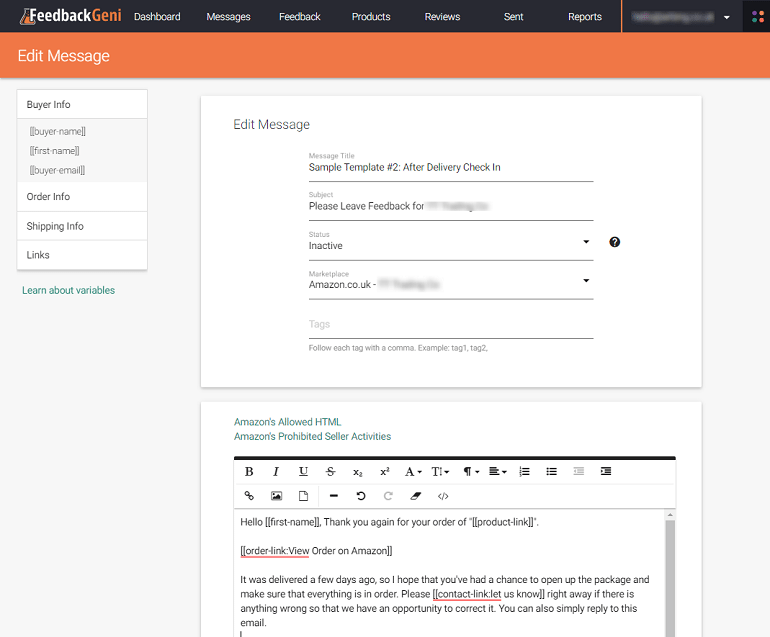
I personally use Feedback Genius. It is very simple to use and has a lot of customizability. There are different plans to choose from but the smallest one is free which allows up to 100 emails a month. Then $20 for the next 1,000 emails.
There are a lot of rules about what you can include in your emails. You cannot:
  • Incentivise a customer to leave a good review. That means no “get 20% off your next order if you leave a good review”.
  • You cannot include a decision tree to filter different types of reviews. That means you are not allowed to say “if you loved the product click here to leave a good review, or if you were in any way unsatisfied please click here to message me directly and I will do everything I can to fix it”.
  • You are also not allowed to include a link to your own website in the email.
You may not get caught if you break these rules. But if you are serious about your Amazon FBA business I strongly recommend you follow them. Amazon has been known to ban people from selling on their platform for inappropriate emailing. If that happens that is the end of your Amazon FBA business.
So if you can’t include any of that, what can you include to encourage them to leave a good review? My personal preference is a two email chain.
The first email simply includes useful information about their purchase and asks that if they are unhappy to email me. Here is my template for some table tennis bats I sell, I change the wording slightly depending on the product and the audience:
Hi [[first-name]],
My name is Sam and I’m one of the creators of the xxxx. Thank you so much for your order!
I wanted to reassure you that we’ve got you covered. If you aren’t completely satisfied with something when your order arrives, then let me know and we’ll get it straightened out for you ASAP.
Additionally, if you have any questions about your order or our products we’d be happy to help you out.
If you’d like to get in touch, you can just reply to this message and we’ll respond promptly. No question is ever too small or unimportant.
I’m going to provide some usage tips for your xxxx:
  • After receiving your bat, the first step is to remove the protective film on each of the black and red rubbers. The rubbers should feel a bit sticky to the touch. It’s this surface that enables you to create the incredible spin that our bats are known for.
  • The bat should be stored in its case between use. If left out for a prolonged period of time the rubbers should be cleaned.
  • As you use the bat, the rubbers will start to attract dust from the ball and will lose their feeling of stickiness. They can be cleaned by wiping them down with a bit of water on a clean cloth.
  • After about a year of heavy usage, the rubbers will slowly lose their spin and should be replaced. They are designed to be easily removed and new rubbers can be stuck down in their place. Alternatively, a new bat can be purchased.
  • The bat has been tested and approved by the International Table Tennis Federation, meaning its legal for use at tournaments of any level. So go, win some matches and enjoy the bat!
All the best,
Sam
This email sets the tone for the level of customer service I want my Amazon FBA business to offer as well as heading off bad reviews before they happen.
My second email asks for a review:
Hey [[first-name]],
First off, I wanted to say thank you once again for your support. Our small business wouldn’t be able to grow and continue to produce top quality table tennis bats without your help.
I noticed your order was delivered a couple days ago, so I hope that you’ve had the chance to try it out and make sure you are happy with everything.
We are always aiming to improve our products and service, and we would really appreciate if you could take 2 seconds to provide us with some feedback:
[[product-review-link:Leave a review]]
Thank you again for your trust and support.
As always, if you have any questions, suggestions or comments, or even just want to have a chat, send us a message by replying to this email and we’ll get back to you as soon as possible.
All the best,
Sam
The text in square brackets is shortcode which Feedback Genius converts into links that are customised for each customer.
Once you have the marketing for your Amazon FBA business down and have conquered your own country, it’s time to expand:

Expand to Different Countries

Once you have started to rank in one country it’s time to expand and do the same in others.
The great thing is that with the central accounts of the UK and USA you can expand your selling to a bunch of other countries with just a few clicks.
For instance, with Amazon UK you can cross-list your items on Amazon Germany. When a customer buys your item in Germany it will be shipped to them from the UK FBA warehouse.
Amazon even provides a translation service so that your listings will be spelt correctly in the target language.
international listings
Congratulations! You now have a multi-national global Amazon FBA business.

Expand to Different Products

Now you are selling strongly everywhere. Time to move on to a new product and start the whole process again. Exceptthis time it should go much smoother and easier.

Recap

Ok. So that was long and complicated. Let’s quickly recap the steps to setting up an Amazon FBA business:
  • Decide on a product idea.
  • Find and open communication with relevant factories on Alibaba that manufacture similar items.
  • Request samples and then commission prototypes to be made.
  • Purchase a barcode.
  • Start manufacturing.
  • Use a freight forwarder such as Flexport to get your stock to the target country and through customs.
  • Open an Amazon Seller Account and create your listings.
  • Create a shipment on Amazon FBA and pre-pay for shipping.
  • Give your freight forwarder the pre-paid shipping labels.
  • Start marketing.
Phew. That was a long post. I think I have covered pretty much everything but if I have missed anything out then please drop me an email. I get quite a few emails and don’t have enough time to reply to all of them, but I will do my best.
I also do a tiny bit of consulting at $200 an hour. If you are in whatever country I happen to be in (check my instagram to see where I am) we can meet up, or you can schedule a call with me through Clarity. It could be specifically on Amazon FBA business, or on anything I talk about on this blog.